The Galactic Hub: ISS Comprehensive Archive 🛰️📖
"The International Space Station is the most complex scientific and technological endeavor ever undertaken." — NASA
orbit 1. The Science of Satellites
At its core, a satellite is any object that orbits a celestial body. There are two types:
- Natural Satellites: Like the Moon orbiting Earth or Titan orbiting Saturn. 🌙
- Artificial Satellites: Human-made machines launched into space for communication, navigation, or research. 🛰️
The ISS is a Low Earth Orbit (LEO) artificial satellite. It maintains an altitude between 370 km and 460 km, where it is still technically within Earth's thermosphere!
public 2. What exactly IS the ISS?
The International Space Station (ISS) is a modular space station (a habitable artificial satellite). It is a joint project involving five participating space agencies:
🇺🇸 NASA (USA)
🇷🇺 Roscosmos (Russia)
🇯🇵 JAXA (Japan)
🇪🇺 ESA (Europe)
🇨🇦 CSA (Canada)
It serves as a microgravity and space environment research laboratory in which crew members conduct experiments in biology, human biology, physics, astronomy, and meteorology.
biotech 3. Why are we up there? (The Purpose)
The ISS is a stepping stone to the rest of the solar system. Its primary goals include:
- 🧪 Microgravity Research: Studying how fire, fluids, and plants act without weight.
- 💪 Human Health: Testing bone density loss and radiation effects for Mars missions.
- 🔭 Earth Observation: Monitoring climate change and natural disasters from above.
- 🛠️ Technology Testbed: Testing water recycling systems that provide 93% efficiency!
history 4. Origins & Construction
The ISS wasn't launched in one piece—it's a giant jigsaw puzzle! 🧩
Construction began in November 1998 when a Russian proton rocket launched the Zarya (Sunrise) module. Two weeks later, the US Space Shuttle Endeavour met Zarya in orbit with the Unity node. Since then, over 40 missions have added modules, trusses, and solar wings to reach its current size of 357 feet (109 meters) long!
speed 5. 17,500 MPH: The Physics of Speed
How does it go so fast? To stay in orbit, the ISS must travel at 7.66 kilometers per second. If it went slower, gravity would pull it back to Earth. If it went faster, it would fly off into deep space! 🌌
The "Perpetual Fall": Isaac Newton explained this best. Imagine a cannonball shot so fast that as it falls, the Earth's surface curves away beneath it at the same rate. The ISS is essentially falling toward Earth forever and missing it! ☄️🔄
view_in_ar 6. Key Components
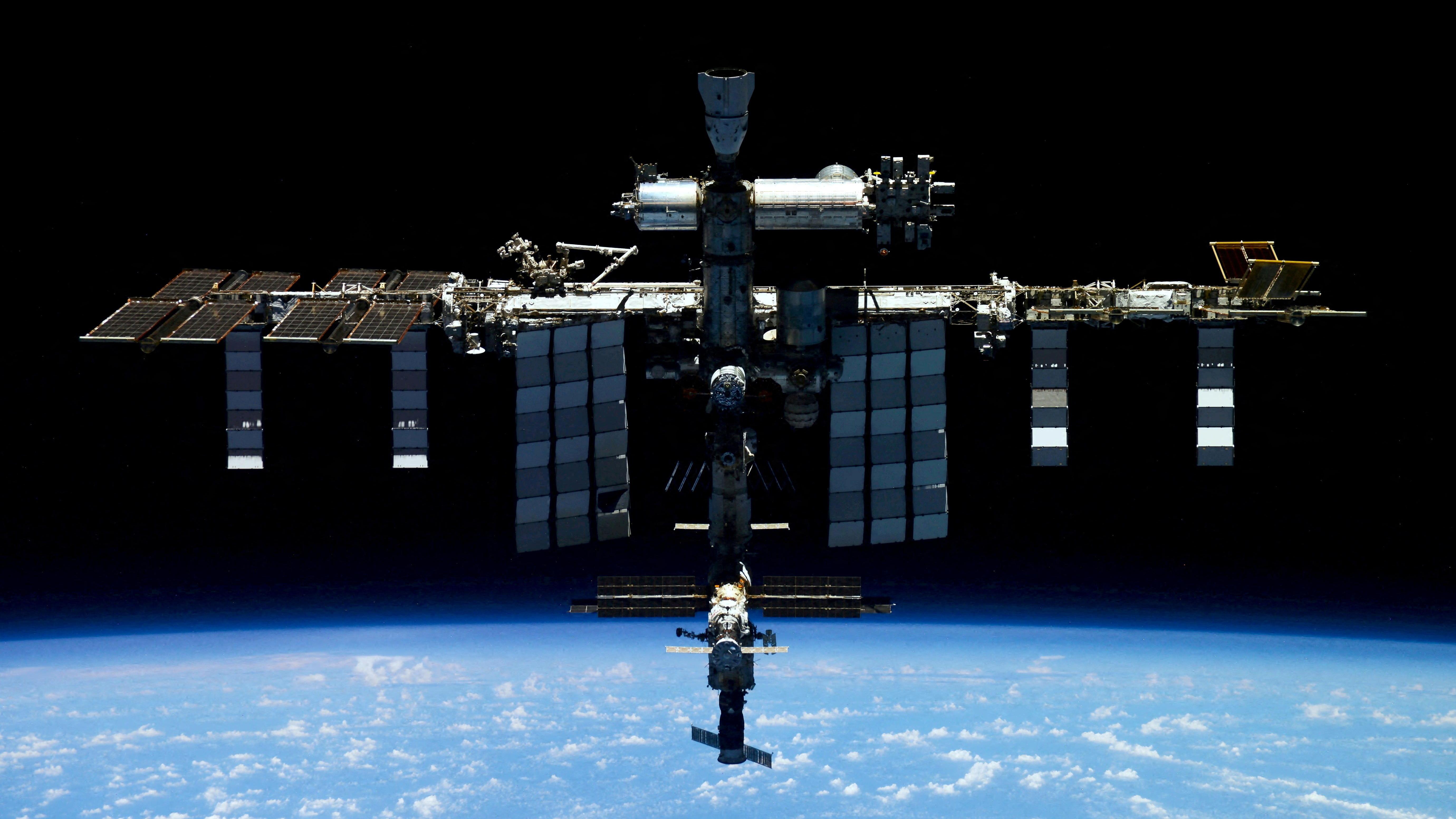
The station is divided into two main segments: the Russian Orbital Segment (ROS) and the United States Orbital Segment (USOS).
Solar Arrays: Four pairs of wings that generate up to 120 kilowatts of electricity. ☀️
Truss: The "backbone" of the station that holds the solar panels and radiators. 🦴
Cupola: A 7-window observatory with the best view of Earth. 🖼️
Canadarm2: A 57-foot robotic arm used for repairs and catching cargo ships! 🦾
restaurant 7. How it all works (Daily Life)
Living in space is weird! 🌀
- Air: Oxygen is generated through electrolysis (splitting water molecules). 🌬️
- Water: Urine and sweat are purified into drinking water that is cleaner than most tap water! 💧
- Exercise: Astronauts must use the T2 Treadmill or ARED (weight machine) to fight muscle atrophy. 🏋️♂️
- Sleeping: They strap themselves into sleeping bags inside phone-booth-sized cabins. 🛌
event_upcoming 8. Timeline of Galactic Milestones
📅 1998: The first module, Zarya, is launched by Russia. The construction begins! 🏗️
📅 2000: Expedition 1 arrives. The ISS has been continuously inhabited ever since! 👨🚀
📅 2001: The US Lab, Destiny, is attached, making it a true world-class research center. 🔬
📅 2011: Construction is "officially" completed after the final Space Shuttle mission (STS-135). 🏁
📅 2020: SpaceX Crew Dragon docks, marking the start of the commercial space era! 🐉
menu_book 9. Glossary for Future Astronauts
- Microgravity:
- The condition in which people or objects appear to be weightless. It's not "zero gravity," just very little! ☁️
- EVA:
- Extravehicular Activity. A fancy name for a spacewalk! 👨🚀🚶♂️
- Telemetry:
- The data being beamed down to Earth (like the stats on your dashboard!). 📡📊
- Apogee:
- The point in the ISS orbit where it is furthest from Earth. 🌍⬆️